
Deciding to switch careers to tech is one of the most practical and empowering career moves you can make today. You do not need a computer science degree, years of advanced calculus, or childhood coding experience to build a fulfilling, well-compensated career in the digital economy. Every year, thousands of professionals from commerce, arts, sales, customer support, and civil engineering successfully switch careers to tech by focusing on practical, demonstrable skills rather than academic credentials.
The modern tech landscape has matured. Companies no longer evaluate candidates solely by their university transcripts; they hire problem solvers who can translate user needs into functional software and intuitive visual experiences. With structured skill training and a deliberate roadmap, you can make this pivot smoothly while maintaining your current day job.
The Changing Reality: Why Non-Tech Backgrounds Are Now an Advantage
When you commit to switch careers to tech, you quickly discover that your existing domain knowledge is not a handicap-it is a distinct advantage. Product teams and digital agencies constantly seek professionals who understand how real businesses function and how everyday users think.
Demystifying the Traditional Computer Science Requirement

For decades, the dominant myth was that software and digital product roles required four rigorous years of algorithmic theory. While foundational computer science remains essential for deep systems programming, the vast majority of commercial software development and product design happens at the application layer. Modern tech recruiters evaluate what you can ship, meaning that your decision to switch careers to tech hinges on demonstrable competency rather than a four-year engineering diploma.
Employers care about clean markup, maintainable styling, responsive interfaces, intuitive user journeys, and effective communication across teams. If your work solves their business challenge, your degree subject becomes irrelevant.
Identifying Your Gateway: Web Development vs. UI/UX Design
Before diving into tutorials, you must clarify which digital discipline aligns with your natural strengths. Clarifying whether you lean toward visual problem-solving or technical implementation makes it significantly easier to switch careers to tech without feeling overwhelmed.
UI/UX Design: Bridging Human Empathy and Visual Systems
User Interface (UI) and User Experience (UX) design revolve around user psychology, product architecture, wireframing, and visual ergonomics. If you enjoy understanding human behavior, organizing information logically, and crafting visually harmonious layouts, product design is a natural fit. This human-centered craft offers an accessible pathway to switch careers to tech for professionals coming from psychology, marketing, business, or the humanities.
Web Development: Turning Logic and Layouts Into Living Products
Web development transforms static design assets into interactive, responsive websites and web applications. Focusing on frontend technologies allows you to switch careers to tech while receiving immediate visual feedback on the code you write. You see every layout change, animation, and button interaction unfold live in your browser, creating a satisfying and iterative learning cycle.
A Step-by-Step Strategic Roadmap for Working Professionals
Attempting to learn everything at once is the primary reason self-taught learners burn out. To transition efficiently without quitting your current employment, you need an actionable blueprint that helps you switch careers to tech systematically.
Step 1: Conduct a Brutally Honest Transferable Skills Audit

You are not starting from ground zero. A career switcher brings valuable soft skills and industry experience that fresh university graduates often lack.
-
Communication and Client Management: If you have handled customer escalations, sales presentations, or team briefings, you already excel at cross-functional communication.
-
Project Organization: Managing deadlines, budgets, and operational workflows translates directly into agile software sprints.
-
Analytical Thinking: Experience in accounting, data analysis, or operations trains your brain to break complex problems into sequential steps.
Recognizing the analytical, organizational, or communication strengths you already own before you switch careers to tech helps prevent unnecessary self-doubt.
Step 2: Choose Structured Skill Training Over Endless Free Tutorials

While the internet is full of free educational videos, unstructured learning often traps beginners in “tutorial hell”—a state where you can follow along with a video instructor but cannot build an independent project from scratch. Enrolling in a guided curriculum ensures you do not waste precious months when attempting to switch careers to tech alongside a demanding work schedule.
Structured skill training provides:
-
A Vetted Curriculum: You only learn the tools and practices current employers actually demand.
-
Mentorship and Code Reviews: Real feedback identifies bad habits before they become second nature.
-
Accountability: A defined schedule keeps you consistent when work fatigue sets in.
Step 3: Build Muscle Memory with Modern Industry Tools
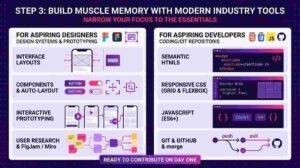
Do not attempt to master twenty disparate tools simultaneously. Narrow your focus to the core software packages standard across tech environments.
-
For Aspiring Designers: Focus on Figma for interface layouts, component design systems, auto-layout features, and interactive prototyping. Complement this with FigJam or Miro for user research mapping.
-
For Aspiring Developers: Master semantic HTML5, modern responsive CSS (Flexbox, Grid), foundational JavaScript (ES6+), and version control with Git and GitHub.
Gaining real fluency in tools like Figma, Git, or modern frameworks enables you to switch careers to tech ready to contribute on day one.
Step 4: Construct Three Proof-of-Work Portfolio Projects
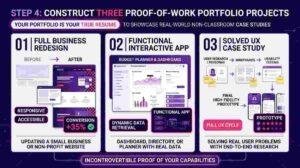
Your portfolio is your true resume. Rather than showcasing generic classroom exercises like basic calculators or to-do apps, construct three comprehensive case studies that mimic real client requirements:
-
A Full Business Redesign: Pick an existing small business or non-profit with an outdated web presence. Redesign and build a clean, responsive, accessible web experience that improves conversion rates.
-
A Functional Interactive Application: Build a dynamic web tool—such as a budget planner, resource directory, or service booking dashboard—that retrieves and displays structured data.
-
A Solved User Experience Case Study: For designers, document the entire UX cycle: user interviews, persona creation, wireframing, usability testing, and the polished final UI prototype.
Assembling detailed, problem-solving case studies allows you to switch careers to tech with incontrovertible proof of your capabilities.
Step 5: Position Your Personal Brand and Network Authentically

Submitting cold resumes to automated corporate job portals yields low response rates for career switchers. Proactively connecting with active practitioners enables non-tech candidates to switch careers to tech through direct referrals rather than automated application portals.
Optimize your LinkedIn profile to reflect your target role. Document your learning journey publicly by sharing short breakdowns of problems you solved, UI components you designed, or lessons learned during portfolio builds. Attend local design meetups, tech roundtables, and creative communities. Genuine professional relationships turn your transition into a collaborative adventure.
It is entirely natural to experience moments of hesitation when you prepare to switch careers to tech while juggling daily life. Managing your mindset is just as critical as writing clean code or mastering Figma auto-layouts.
Designing a Sustainable Part-Time Study Habit
Do not attempt to study four hours every night after an exhausting eight-hour workday. Exhaustion kills retention. Instead, commit to a sustainable baseline:
-
Weekdays: 60 to 90 minutes of focused, distraction-free practice each morning or evening.
-
Weekends: One deep-work block of 3 to 4 hours dedicated to building portfolio projects.
Consistency over six months easily outperforms irregular, frantic bursts of late-night cramming.
Reframing Non-Tech Experience into a Unique Competitive Edge
When imposter syndrome strikes, remind yourself that technology exists to serve industries you may already understand inside and out. An accountant learning frontend development understands financial tech platforms far better than a standard junior developer. A retail manager mastering UI/UX understands the friction in e-commerce checkout flows intuitively. Your past career history is not baggage—it is your competitive differentiator.
Turning Ambition into Action: Your Next Milestone
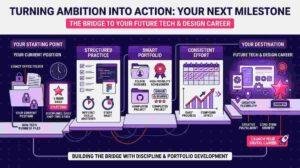
A digital career offers creative fulfillment, location flexibility, and substantial long-term growth. The gap between your current position and your future tech role is simply a bridge of structured practice, smart portfolio development, and consistent effort. Start with one dedicated hour each evening, trust the compound effect of disciplined practice, and switch careers to tech on terms that work for your life.
Read Our Next Useful Insights: Tech Jobs Without a Degree: 3 Easy Ways